Meditations - Marcus Aurelius, Pressure, and Inner Rule
A fuller guide to the Roman emperor's private Stoic notebook: not a quote book, not a productivity hack, but a record of one mind trying to stay answerable under pressure.
Sua's Quick Take
Meditations is famous enough now that it can feel almost too familiar. The internet has turned Marcus Aurelius into a supplier of clean little sentences about discipline, focus, and not caring what people think. But the book itself is stranger, rougher, and more moving than that.
This is not a calm man explaining life from a finished place. It is a man in power, aging, often ill, surrounded by war and obligation, writing to himself because he knows how easily the mind can slide into irritation, vanity, fear, laziness, or self-pity.
That pressure is what keeps the book alive. Marcus is not asking for a softer life. He is asking how a person can keep judgment clean when life refuses to become simple.
What Kind of Book Is This?
Marcus Aurelius ruled the Roman Empire from 161 to 180 CE. He was not a professor writing a system, and he was not an author shaping a public book. Meditations is closer to a private workbook: reminders, rebukes, fragments of gratitude, moral drills, and short arguments he repeats until they begin to sound less like ideas and more like exercises.
The twelve books do not build like a modern nonfiction book. There is no neat first principle, middle development, and final conclusion. Some entries feel polished. Others feel abrupt. A few circle back to points Marcus has already made many times. That unevenness can frustrate a first-time reader, but it also reveals the book's real texture. He is not arranging a lecture. He is returning, again and again, to the places where his own mind leaks strength.
The core question is blunt: if you cannot command death, reputation, other people's opinions, your body's condition, political disorder, or the fact that everything changes, what remains under your care?
Marcus keeps answering with the same narrow list: your judgment, your intention, your present action, and the way you treat other human beings. The list is small, but it is not easy.
Why It Still Feels Different From Modern Self-Help
Modern self-help often starts by promising improvement: better mornings, better productivity, better confidence, better results. Meditations starts from a harsher place. It assumes that life will keep bringing insult, illness, death, fatigue, incompetence, and disappointment. The goal is not to design a life where nothing touches you. The goal is to stop giving every disturbance the right to govern your mind.
That difference matters. Marcus does not write as if the self is a brand to optimize. He writes as if the self is a small moral jurisdiction. You cannot rule the empire of events, but you can rule the court in which impressions become judgments and judgments become actions.
The book is also more social than its reputation suggests. Many online versions of Stoicism shrink it into emotional self-protection: care less, react less, stay unbothered. Marcus says something more demanding. Do not be ruled by other people's faults, but also do not use their faults as an excuse to become unjust. Human beings, he insists, are made for cooperation. Inner rule is valuable because it changes how you act in the world.
That is why Meditations belongs in nonfiction classics. It is not a story, but it has a deep movement: from inherited examples, to self-command, to mortality, to public duty, to the practice of accepting reality without abandoning responsibility.
Book Contents
Meditations does not unfold as a single argument. It survives as twelve books of recurring pressure points: gratitude, attention, mortality, public duty, other people's faults, and the effort to keep judgment clean. This outline gives the shape of the book before the fuller summary begins.
- Book I: gratitude and moral inheritance
- Book II: the beginning of the day, human difficulty, and mortality
- Book III: refusing delay and keeping present character intact
- Book IV: inner retreat and the discipline of judgment
- Book V: reluctant mornings and human duty
- Book VI: simplicity, public power, and the stripping away of vanity
- Book VII: short reminders for balance under pressure
- Book VIII: lowering the weight of reputation
- Book IX: injustice, anger, and social responsibility
- Book X: removing exaggerated interpretations
- Book XI: speech, conduct, and dignity among others
- Book XII: present judgment under the pressure of death
Content Summary
Meditations does not move by plot. It moves by repeated acts of attention. A useful summary therefore has to follow the pressure Marcus keeps returning to: what he inherits from others, what he must correct in himself, how he handles other people, and how he tries to accept reality without becoming passive.
The twelve books are not equal in shape. Book I is almost a ledger of gratitude. Books II and III tighten the question of mortality and present duty. The middle books circle the disciplines most readers now associate with Stoicism: separating event from judgment, lowering the power of reputation, doing the work assigned by nature, and refusing to let irritation become a second injury. The later books grow more compressed, as if Marcus is carrying shorter and shorter rules into a life where public duty, bodily frailty, age, and death all press closer.
Because the work is a notebook, its repetition is part of the meaning. Marcus is not trying to entertain a reader with novelty. He is rehearsing truths he does not trust himself to remember automatically. He returns to the same few questions because they are the questions that keep becoming difficult: Can I meet other people's faults without hating them? Can I accept what happens without becoming lazy? Can I hold public responsibility without being purchased by praise? Can I remember death without wasting the life still in front of me?
Book I: a life built from other people's examples
The first book can look like a formal list of thanks. Marcus names his grandfather, parents, teachers, adopted father, friends, philosophical models, household companions, wife, children, and the gods. Read quickly, the section may feel ceremonial. Read carefully, it becomes a map of moral inheritance.
Marcus does not begin by saying, "Here is what I believe." He begins by saying, in effect, "Here are the people who showed me how to live." Gentleness came through his grandfather. Modesty and a kind of masculine seriousness came through the memory of his father. His mother taught piety, generosity, simplicity of diet, and the refusal not only to commit wrong but even to nurse the intention of wrong. His great-grandfather valued education enough to bring teachers into the home. The person who raised him trained him away from factional passions in the circus and amphitheater, away from easy slander, and toward doing his own work.
This opening quietly corrects a common misunderstanding of Stoicism. The Stoic is not a sealed, self-created individual who owes nothing to others. Marcus begins with dependence. His inner life has been formed by parents, teachers, friends, and examples. Philosophy starts with gratitude before it becomes discipline.
The list also shows what kind of virtues Marcus prizes. They are mostly unglamorous: restraint, plain living, steadiness, frank speech, endurance, patience with criticism, seriousness without harshness, and public responsibility without theatrical display. Diognetus turns him away from superstition, magical showmanship, and childish amusements, and also opens the door toward philosophy. Rusticus makes the turn deeper. Through Rusticus, Marcus learns to distrust rhetoric for its own sake, to revise his own character, to read carefully, to accept correction, and to discover the writings of Epictetus. Philosophy comes to him not as an ornament of education but as a discipline that exposes vanity.
Several teachers shape his handling of language and people. Apollonius gives him an image of independence that is not coldness: firmness under pain, freedom from caprice, and a steady temper whether fortune is generous or severe. Sextus models kindness, domestic order, and a manner of teaching that corrects without humiliating. Alexander the grammarian shows him how to avoid pedantic fault-finding and how to correct errors gently, by offering better wording without making the other person feel attacked. Fronto teaches him to recognize the envy, duplicity, and hypocrisy that can gather around power. Alexander the Platonist warns him against using busyness as a way to evade human obligations.
The longest and most politically important portrait is Antoninus Pius, Marcus's adoptive father and imperial predecessor. Marcus presents him as the model of restrained rule: accessible, steady, sparing in expense, slow to anger, attentive to the common good, unmoved by flattery, careful with public funds, and able to enjoy honors without becoming dependent on them. Antoninus knows when to deliberate and when to decide. He can relax without dissolving into indulgence. He respects custom without being imprisoned by pomp. In the whole book, this portrait matters because it gives Marcus a practical image of power under discipline.
Book I closes by widening gratitude beyond human teachers. Marcus thanks the gods for the family, tutors, opportunities, bodily conditions, warnings, and delays that kept him from worse habits. Even weaknesses become part of the moral education: he is grateful that he did not go too far into rhetoric, superstition, lust, or cruelty; grateful that he had examples near him before power could harden him; grateful that his life gave him time to recognize what needed correction.
The book's movement is therefore not merely biographical. It tells the reader how Marcus thinks character is made. We become ourselves through examples repeatedly seen, words repeatedly heard, disciplines repeatedly practiced, and corrections accepted before pride can reject them. The emperor who will spend the rest of Meditations telling himself to govern his own judgment first admits that his judgment was educated by others. Self-rule begins with remembering one's debts.
Book II: expect human difficulty before the day begins
Book II opens with one of the most practical moves in the whole work. Marcus tells himself before the day begins that he will meet meddling, ingratitude, arrogance, deceit, envy, and unsocial behavior. This is not a license for contempt. It is a way of refusing surprise.
The point is not, "People are terrible, so withdraw." The point is, "People are often confused about good and evil, so do not let their confusion govern your own conduct." Marcus believes the wrongdoer has lost sight of what is truly good and bad. If that is so, then another person's fault is not a reason to become hateful in return. The wrongdoer is still kin, not because every act is harmless, but because rational beings share a common nature and are made for cooperation. Anger at human beings for being morally confused is like anger at a body for having limbs that belong to one another.
This is one of the book's hardest demands. Marcus does not deny that people can injure, obstruct, insult, or betray. He insists that they cannot force him to make his own ruling faculty unjust, resentful, or false. The early discipline is therefore protective: expect difficulty, name it clearly, and meet it without surrendering the part of yourself that remains yours.
Book II also keeps death close. Life is short; clarity is not guaranteed; the present day is not a rehearsal. Marcus reminds himself that the body is fragile, breath is brief, reputation is unstable, and the soul can be carried away by impressions before it has examined them. Mortality is used as pressure, not decoration. It strips away vanity and asks whether the next act can be done honestly.
The book repeatedly narrows the field of responsibility. Do not wander through other people's souls. Do not spend life guessing what they think, building imaginary audiences, or trying to manage the verdicts of people whose own judgments are confused. Attend instead to the work directly before you. Ask whether the action is just, whether the intention is clean, whether the impression has been tested, and whether the present moment is being used or wasted.
Marcus also begins here to treat philosophy as something more physical than abstract. The soul must stand upright. The ruling part must not be dragged around by appetite, fear, or theatrical grief. The body will decay; the social world will misunderstand; time will erase almost every name. What remains is the practice of keeping reason active while there is still a day in which to act.
Book II therefore sets the working conditions for the rest of Meditations. Other people will be difficult. The body will be vulnerable. Death will not wait for the mind to become perfectly ordered. Fame will not secure anything essential. Under those conditions, Marcus chooses the smallest durable jurisdiction: judge accurately, desire only what belongs to virtue, refuse resentment, and do the human work at hand.
The force of the opening exercise is that it begins the day without either optimism or contempt. Marcus does not protect himself from disappointment by giving up on people in advance. He names the likely failures of the people he will meet, and then immediately remembers that they remain part of the same rational community. The forecast is ethical preparation, not social withdrawal. Because difficulty is expected, it should not be allowed to write the character of the person who expected it.
Book III: do not postpone the work of becoming clear
Book III presses harder on delay. Marcus reminds himself that even if life lasts, the powers of attention and judgment may weaken. A person can become older without becoming wiser. The mind can grow dull through habit, comfort, fatigue, public performance, and the slow erosion of seriousness. It is not enough to say that death is coming. One must also notice that the capacity to live well can decline before death arrives.
That thought gives the book its urgency. Marcus is not simply afraid of dying. He is afraid of never beginning to live according to the standard he already recognizes. The body may continue; the social role may continue; honors and tasks may continue. But the inward power that can examine an impression, choose a just act, and refuse a corrupt motive may become weaker through neglect. Delay is not neutral. It trains the wrong habits.
The book's real question is: what kind of person are you becoming right now? Marcus distrusts the fantasy of better conditions. Do not wait for retirement, quiet, praise, philosophical leisure, or ideal circumstances before living with discipline. The moral life begins in the present sentence, the present decision, and the present refusal to act falsely.
Book III also attacks the part of the mind that wants to look outward for rescue. Marcus turns away from reputation, from the admiration of later ages, from the wish to appear clever, and from the habit of letting other people's business occupy the center of attention. What matters is not whether a gesture looks noble from the outside. It is whether the ruling faculty remains aligned with truth, justice, moderation, courage, and reverence for the whole.
He returns several times to the idea that every action should be performed as if it were the last. This is not a call for panic or melodrama. It is a rule against carelessness. If the present action might be the final complete expression of one's character, it should not be lazy, spiteful, evasive, or vain. Marcus wants the mind to stop treating life as a draft that will later be revised under calmer conditions.
There is also a strong bodily realism in the book. Beauty, pleasure, appetite, and youth are reduced to physical processes so that the mind will not be enchanted by surfaces. Marcus is not trying to make the world ugly. He is trying to see through glamour when glamour begins to rule judgment. The same method will return later with food, clothing, sex, fame, and ceremony: look at the thing plainly, and its false sovereignty weakens.
Death remains near, but it does not turn the chapter into gloom. It makes the present sharper. If life is limited, the answer is not theatrical intensity. The answer is cleaner action. The person who understands this does not need to be seen performing wisdom. He needs to become less divided: less pulled by appetite, less dependent on applause, less delayed by excuses, and more ready to do the thing that reason has already shown.
Book IV: the disturbance often comes from judgment
Book IV develops one of the work's most famous inner movements: return to the mind. People search for retreats in the countryside, by the sea, or in the mountains, but Marcus insists that the closest retreat is within. The mind can withdraw, inspect itself, renew its principles, and return to order.
This is not escapism. Marcus is not telling himself to ignore events. He is asking where the disturbance actually takes shape. A remark, loss, bodily discomfort, political frustration, or public failure may come from outside; the verdict that it is unbearable is formed inside. The event enters the field of life. The judgment gives it power over the soul.
Book IV teaches the reader to slow down the verdict. What happened? What have I added to it? What remains mine to do? That sequence becomes one of the basic disciplines of Meditations. Marcus repeatedly tells himself that things do not touch the soul unless the soul forms opinions about them. The soul is disturbed not by the bare fact but by the interpretation it accepts too quickly.
The book is also one of the clearest places where Marcus thinks cosmically. Everything changes into something else. Bodies dissolve, names fade, generations vanish, and the universe keeps remaking its material. To a modern reader, this can sound bleak, but Marcus uses change to loosen possessiveness. If all things are in motion, then clinging to fixed arrangements is a way of fighting the very structure of reality. The more exact response is to accept change and ask what virtue requires inside it.
Fame receives especially severe treatment. Marcus keeps shrinking the audience. Those who praise you will die; those who remember them will die; the future itself will become forgetful. Even if a name travels for a while, the minds carrying that name are unstable, partial, and occupied by their own anxieties. Reputation, then, is not evil, but it is too weak to serve as the measure of life.
Book IV also gives the inner retreat a civic dimension. Marcus is not withdrawing from humanity. He is trying to return to humanity with a cleaner mind. If human beings are citizens of one common universe, then the private work of judgment is never merely private. A disordered judgment becomes anger, injustice, vanity, cowardice, or cruelty in public. A corrected judgment becomes patience, usefulness, and proportion.
The chapter keeps alternating between vastness and minuteness. On one side are universal nature, endless change, and the smallness of human fame. On the other side is the next act, the next opinion, the next refusal to exaggerate. Marcus's method is to move between these scales until the ego loses its false centrality. The whole is enormous; the present duty is small; both facts are freeing.
By the end of Book IV, the reader has the outline of a Stoic exercise that will keep returning. Strip the event of the story added to it. Remember that everything mortal is already passing. Refuse to turn another person's confusion into your own. Do not ask the future to secure your peace. Retire inward, not to hide, but to recover the principles that make outward action just.
That last point keeps the inner retreat from becoming a private shelter of self-absorption. Marcus withdraws so that he can return with better judgment. Before insult becomes injury, before loss becomes ruin, before discomfort becomes the whole meaning of a day, the mind can pause and examine the verdict it is about to pronounce. The pause is small, but it is where much of the freedom in Meditations actually lives. The event may remain difficult; the added tyranny of interpretation can still be challenged.
Book V: even a reluctant morning contains a duty
Book V is famous for the scene of getting out of bed. Marcus speaks to the part of himself that wants more sleep, more warmth, more comfort, more delay. The problem is ordinary, which is why the passage still works. Even an emperor has to face the dull resistance of the morning.
His answer is not productivity culture. He does not say, "Rise early so you can win." He says, in effect, "Rise because you are human, and human beings have work to do." Bees, horses, plants, and birds move according to their nature; a human being's nature is tied to reason and cooperation. To refuse the work of a human being is not simply to miss a task. It is to live below one's own nature.
That makes duty unglamorous. It is not a feeling of nobility. It is the plain fact that there is a task before you, and your mood is not the final judge of whether it should be done. Marcus does not pretend that the body will always consent. He simply denies the body's claim to rule the whole person.
Book V then extends the same discipline beyond morning reluctance. Events arrive through the order of nature; actions belong to the present; the mind must decide whether to cooperate with what reason shows or complain that the world has not arranged itself more conveniently. The temptation is to treat every obstruction as a personal insult. Marcus wants to receive it instead as material. If something happens, it becomes part of the field in which virtue must act.
The social tone of the book is important. Marcus repeatedly returns to the idea that rational beings exist for one another. A hand, foot, eyelid, or row of teeth is absurd if it works against the body to which it belongs; human beings are similarly disfigured when they work against their common nature. This does not make every human action good. It means that revenge, contempt, and withdrawal are usually failures to understand the whole to which one belongs.
He also warns himself against doing good in the wrong spirit. A vine bears grapes and asks for nothing more; a horse runs, a dog tracks, a bee makes honey. Human beings often perform one useful act and immediately turn toward recognition, gratitude, or self-admiration. Marcus wants a cleaner kind of goodness: do the work, let it be complete in itself, and move to the next act without demanding a witness.
The book's treatment of discomfort is equally strict. If something is bearable, bear it without adding complaint. If it is not bearable, death will end it. That sentence can sound severe, but its purpose is to break the imagination's habit of treating every pain as infinite. The mind often suffers twice: once from the thing itself and again from the story that the thing is limitless, shameful, or uniquely unjust. Marcus wants to stop the second suffering where he can.
Book V therefore turns daily resistance into a philosophical test. The point is not to become harsh with oneself. The point is to become harder to purchase with comfort, harder to paralyze with mood, and harder to make vain through useful action. The human being wakes into duty, not into a life designed around private preference. That duty may be public, domestic, bodily, administrative, or inward. Whatever its form, it asks the same question: will the ruling part lead, or will the first reluctance decide?
This makes Book V more demanding than a simple command to be productive. Marcus is not measuring life by output. He is asking whether the first feeling of reluctance has the authority to define the whole person. Rest has its natural place, and the body is not an enemy, but comfort becomes corrupting when it quietly becomes the final standard. Duty, in this book, is the name for a steadier orientation: do the human work because it belongs to a rational and social being, not because the mood has become inspiring or the audience has become generous.
Book VI: simplicity inside power
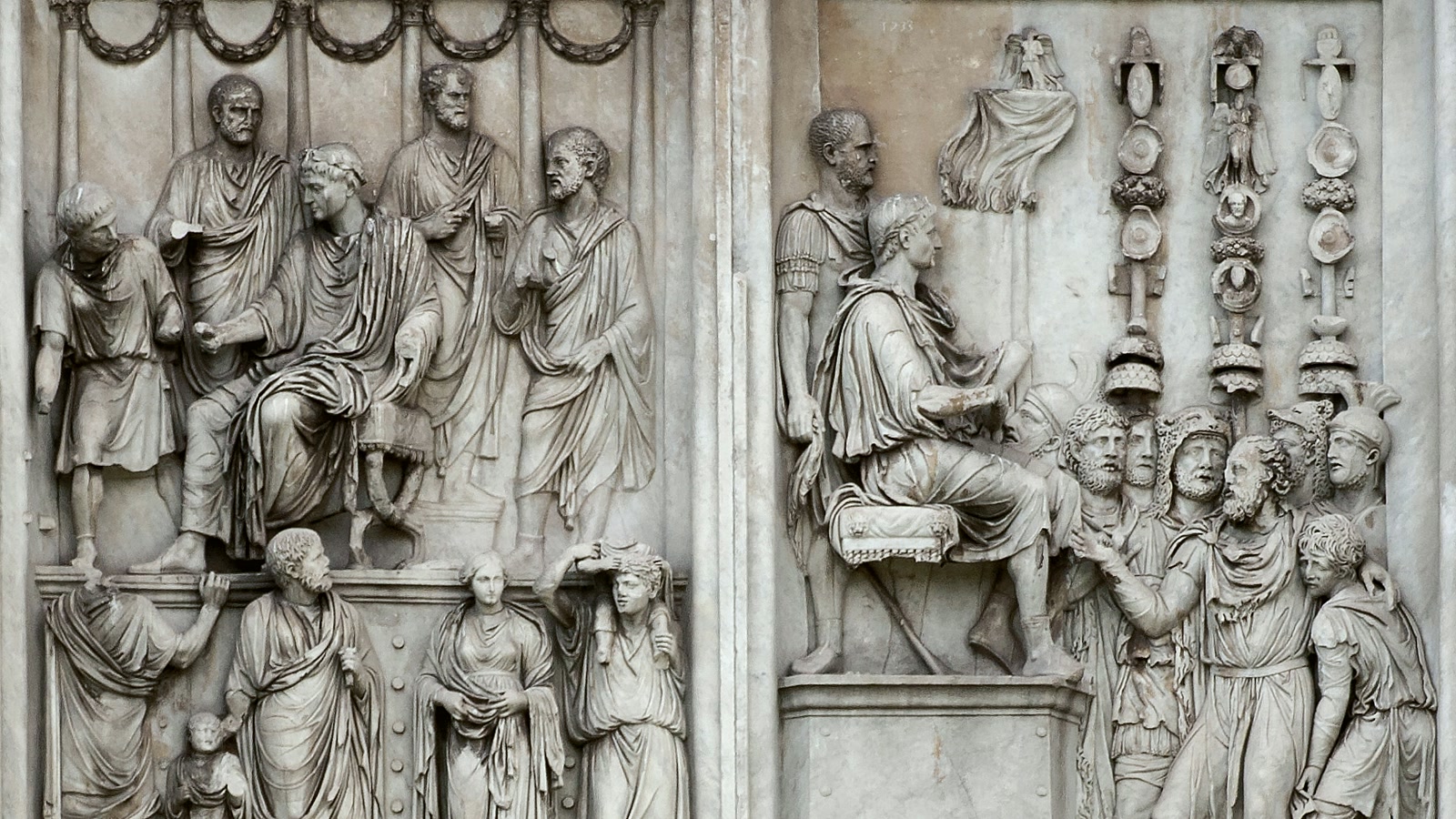
Book VI often feels like Marcus trying to protect himself from the illusions of rank. He lives at the center of empire, but he keeps pulling the mind away from grand names. Luxury, ceremony, fame, and status can inflate the self until it can no longer see things plainly.
So he practices reduction. Fine food becomes matter passing through the body. Expensive clothing becomes dyed fiber. Sexual glamour becomes a physical act stripped of fantasy. Imperial ceremony becomes a set of costumes, voices, gestures, and opinions. Fame becomes a few unstable judgments in other people's minds. This is not disgust with the world. It is a method for cutting away the glamour that makes false things look ultimate.
Book VI asks how a powerful person can remain less corrupted by power. The answer is not heroic. Look simply. Judge accurately. Do not harm. Do not make your role larger than the truth.
The chapter is especially alert to the difference between a role and a soul. Marcus can be emperor, judge, commander, father, citizen, patient, and mortal man, but none of those roles should be allowed to cloud the ruling faculty. The office may require ceremony. It does not require vanity. The office may require decisions that affect many people. It does not give him permission to forget that he is one changing body among other changing bodies.
Marcus keeps returning to Antoninus as an inward standard. The model is not brilliance but steadiness: moderation in food, patience with tedious business, careful listening, resistance to flattery, indifference to empty honors, and constancy in friendships and public service. The fact that Marcus needs to remember these things while ruling tells us something about the danger of rule. Power surrounds a person with invitations to self-importance. A disciplined ruler must keep undoing the enchantment.
The book also develops a gentler but no less serious view of other people. It is easy to accuse, easy to be irritated, easy to imagine oneself morally separate from the confused crowd. Marcus instead tells himself to see the causes behind behavior. People act from beliefs, habits, fears, ignorance, and desires. Understanding the cause does not excuse wrongdoing, but it can reduce the pleasure of contempt. If another person is wrong, teach if possible; if not possible, keep your own work clean.
Several entries return to the present as the only workable unit of life. The past is gone; the future is not yet in hand; the present is brief but sufficient for a just act. This keeps the philosophy from dissolving into abstraction. Marcus may contemplate the whole cosmos, but his moral task always comes back to the next judgment, the next conversation, the next administrative decision, the next chance to be less vain.
Book VI also refuses perfectionism as an excuse for delay. A person can live well in the court, in the camp, amid illness, among difficult people, and under the pressure of incomplete knowledge. The question is not whether conditions are philosophically clean. The question is whether the person inside those conditions can remain honest, social, self-governed, and useful.
In this book, simplicity is not rustic fantasy. Marcus does not escape power by pretending he is not powerful. He tries to strip power of its hallucinations. The world may call certain things splendid, but the trained mind asks what they are made of, what they are for, how long they last, and whether they help the soul become more just. That habit of plain sight is one of the book's most durable defenses against corruption.
Book VII: short sentences as mental handholds
Book VII is full of compact statements. It can feel almost aphoristic, but the shortness has a purpose. Marcus is writing thoughts that can be remembered under stress: do the good before you, do not surrender to external impressions, live according to nature, return to the present act.
The book shows why repetition matters. Marcus is not repeating because he has nothing else to say. He repeats because knowing a principle is different from remembering it when insulted, tired, frightened, praised, or physically uncomfortable. A long argument may persuade in leisure. A short sentence can steady the mind when leisure is gone.
Book VII also works against melodrama. Human beings err, age, desire, and disappear. Life is serious, but the ego's drama is not always as serious as it feels. The useful move is to return to the next possible good.
One recurring exercise is to separate what happens from the commentary wrapped around it. If something external is painful, Marcus asks whether the pain is in the thing itself or in the opinion formed about it. If the opinion is unnecessary, the mind can release it. If action is required, action can proceed without the extra weight of grievance. The point is not to make the person passive. It is to keep action from being governed by panic or wounded vanity.
Book VII also gives one of the work's most useful images for pressure. The art of living is closer to wrestling than dancing: not because life should be aggressive, but because it rarely follows a rehearsed pattern. Balance has to be kept while force arrives from angles one did not choose. Marcus wants philosophy to train that stance. It should make a person ready for interruption, not dependent on perfect choreography.
The book continues to press the social meaning of Stoicism. Human beings are made for mutual work, but that does not mean they will always be agreeable, grateful, or fair. Marcus keeps insisting on a double discipline: do not be surprised by faults, and do not let faults dissolve your commitment to justice. To be useful among human beings is harder than to be calm alone. The calm matters because it helps one remain useful.
There is also a repeated return to the inner standard. Instead of asking whether the act will be admired, Marcus asks whether it fits the nature of a rational and social being. Instead of asking whether the result is secure, he asks whether the intention is straight. This changes the emotional economy of action. The person no longer has to possess the outcome in order to act well.
Book VII's many short entries make the notebook feel like a pocket discipline. Some are reminders about death. Some reduce fame. Some point toward the order of the whole. Some urge Marcus to endure pain, examine impressions, think of the common good, or remember admired examples. Their shared function is to keep the soul from scattering. When pressure comes, the mind needs handholds.
That is why the book's compression is not thinness. It is a form of training. Marcus is turning philosophy into phrases that can be carried into a tent, court, sickroom, council, or difficult conversation. The summary of Book VII is not a new doctrine but a sharpened practice: pause, name the impression, lower the drama, act justly, and do not make a second injury out of your own judgment.
Book VIII: lower the weight of praise and blame
Book VIII repeatedly reduces the power of reputation. We spend enormous energy imagining how others judge us. Marcus keeps answering that those judges are mortal, partial, distracted, and often confused. Their praise and blame are real social facts, but they are not a reliable measure of worth.
He is not asking for antisocial indifference. He still believes human beings are made for one another. The question is whether another person's opinion should become the ruler of your action. If goodness depends on applause, goodness becomes performance.
Book VIII shifts the standard inward. Not "Who noticed?" but "Was it true?" Not "Will they approve?" but "Did I do the work that belonged to me?" That change of question is one way the mind becomes harder to purchase.
Much of the book is built around wasted attention. Marcus warns himself not to spend the remaining part of life imagining what other people are thinking, unless doing so serves the common good. This is a sharp psychological observation. A person can lose entire days to imagined spectators: defending himself before people who are not present, revising past conversations, anticipating criticism, or craving approval from people whose standards he does not even respect. Marcus treats that habit as a theft from the present.
He also returns to the idea that the soul can remain unharmed if it does not consent to being harmed in its own proper work. The body may be hurt. Reputation may be damaged. Plans may be blocked. But the capacity to judge truthfully and act justly is not destroyed by another person's opinion. The difficulty is that the mind often volunteers its freedom before anyone can take it. It agrees to be ruled by praise, blame, insult, rumor, or fear.
Book VIII keeps measuring actions by nature. What is human nature? Not pleasure alone, not display, not victory over other people, but rational and social activity. If an act is selfish, petty, or false, it is not merely unattractive. It is against the shape of the creature performing it. If an act is truthful, just, moderate, and useful, it already has its reward in being the act of a human being living according to what he is.
Marcus also gives attention to obstacles. What blocks one line of action may become material for another. If a plan is obstructed, the obstruction does not necessarily obstruct patience, fairness, courage, honesty, or resourcefulness. This is one reason his philosophy is not passive. He does not say that nothing matters. He says that the field of virtuous action is wider than the field of preferred outcomes.
He also asks the reader to look at ordinary annoyance without overbuilding it. If a cucumber is bitter, set it aside. If brambles are in the path, avoid them. Do not turn every inconvenience into a metaphysical complaint. Marcus is not being trivial. He is training proportion. Many disturbances become tyrannical because the mind treats them as if they require cosmic protest when they only require a simple response.
The book's treatment of death is quieter than in some earlier sections, but it remains active. Praise and blame shrink when the praiser and blamed alike are passing away. This does not make human community meaningless. It makes vanity look foolish. To live for reputation is to entrust the soul to a crowd that will itself vanish and that often does not understand what it is praising.
By the end of Book VIII, Marcus has made reputation smaller without making conduct smaller. That distinction is central. He does not use the emptiness of fame as a reason to become careless. He uses it as a reason to become more exact. If the audience is unreliable, then the act itself must be judged by a better standard. If praise is unstable, then truthfulness matters more, not less.
The reputation passages also expose an invisible courtroom inside the mind. A person can spend the present moment arguing before imagined spectators: defending an old decision, rehearsing a future criticism, or reshaping an act so that it will be easier to admire. Marcus does not deny that public judgment exists, especially for someone in public office. He denies that it should become the highest court. Correction may come from others, but the soul should not be sentenced by the unstable appetite for approval.
Book IX: injustice does not excuse your own disorder
Book IX deals closely with wrongdoing. Marcus does not pretend injustice is harmless. Lying, greed, betrayal, violence, and cruelty violate the social nature of human life. A person who acts unjustly has misunderstood what human beings are for.
But another person's wrongness does not give Marcus permission to become wrong in return. Anger can disguise itself as justice. Resentment can feel morally serious while quietly taking over the mind.
The distinction matters because Marcus is not trying to make injustice look small. He is trying to make the response more exact than anger usually allows. Anger may announce that something is wrong, but it is a poor ruler after the announcement has been made. It wants vindication, not always correction. A person may need to oppose, rebuke, punish, or protect, but those actions become morally different when they are governed by justice rather than by the pleasure of righteous hostility.
That is why Book IX is difficult. It asks the reader to oppose injustice without becoming ruled by hatred, to see wrongdoing clearly without letting it define the shape of one's own soul. This is Stoicism as a social discipline, not private detachment.
Marcus repeatedly describes injustice as a kind of impiety because it breaks faith with the common nature that binds rational beings. The unjust person is not merely violating a rule. He is cutting himself off from the community for which he was made. Yet the observer who responds with hatred risks another kind of separation. He may condemn injustice while imitating its disorder in his own ruling faculty.
The book therefore builds a demanding sequence. First, understand the wrong as wrong. Second, remember that the wrongdoer acts from ignorance, false value, passion, or misjudgment. Third, correct if correction is possible. Fourth, if correction is not possible, do not add your own corruption to the situation. Marcus is not saying that justice requires softness toward every act. He is saying that justice cannot be entrusted to a soul that has surrendered itself to rage.
Book IX also returns to the difference between injury and harm. Someone may obstruct Marcus's work, insult him, or act unjustly toward him. But the deeper harm would be for Marcus to become unjust, false, cowardly, or bitter in response. This distinction can feel austere, especially when the external injury is real. Marcus's point is not that external injuries are imaginary. It is that the moral condition of the person responding remains the most important field under his own care.
The book also asks why people are so drawn to complaint. If events arise within the order of nature, and if human beings are known to behave badly when confused about value, then endless astonishment becomes a form of forgetfulness. Marcus does not want to be naive. He wants to stop treating predictable human failure as if it were a personal violation invented for him alone.
Death again serves as a solvent for anger and pride. The person who wrongs you is mortal. You are mortal. The people who will judge the conflict are mortal. The anger that feels enormous today will soon belong to bodies returned to the elements. This does not erase accountability, but it does make hatred look less grand. Under the aspect of mortality, the question becomes simpler: what action is just now?
Book IX is also one of the places where Marcus's social vision becomes most obvious. He rejects both sentimental optimism and contemptuous withdrawal. People are flawed; society is full of injustice; wrongdoing should be named. Yet human beings remain made for cooperation. To abandon that truth because cooperation is difficult would be to let other people's confusion define one's philosophy.
The book's practical force lies in that balance. Do not romanticize the wrongdoer. Do not imitate him inwardly. Correct where you can. Endure where you must. Keep the common good in view. Let anger alert you to the presence of wrong, but do not let it become the ruler that decides your speech, your judgment, or your next act.
Book X: remove what makes life less exact
Book X is full of attempts to strip away exaggeration. People suffer not only from events, but from the imagined stories attached to events: that an insult has ruined them, that future loss is already present, that recognition is necessary, that discomfort is unbearable, that another person's stupidity has the right to occupy the whole mind.
Marcus tries to see things without that added fog. This is not cynicism. It is preparation for cleaner action. When an event is no longer swollen by fantasy, the next duty becomes smaller and clearer.
Book X also keeps him from easy self-approval. It is not enough to admire virtue or talk about philosophy. The question is whether the next action has become more truthful, more just, less vain, less evasive.
The book opens with an address to the soul, and the tone is intimate but unsparing. Marcus asks whether the soul will ever become good, simple, unified, naked before itself, and more pleased by its own integrity than by external pleasure. The language matters because it shows the distance between aspiration and condition. He is not congratulating himself. He is pressing himself toward a simplicity he knows he has not fully reached.
Book X often sounds like a campaign against mental ornament. Remove the story. Remove the desire to be praised. Remove the fear that something external has made the soul worse. Remove the habit of calling life intolerable when what has happened is merely hard, ordinary, or contrary to preference. Once the ornament is removed, an event may still require courage, repair, or endurance, but it no longer becomes a theater in which the ego performs injury.
Marcus also emphasizes teaching. When someone is wrong, show him the mistake if possible, and do it with gentleness. If he cannot see it, the failure is not yours. This is an important corrective to a harsh reading of Stoicism. Marcus does not imagine wisdom as silent superiority. He imagines a social effort to help others see better, limited by the fact that no one can force another person's ruling faculty to consent.
Book X also deepens Marcus's habit of looking at things by their causes, materials, and ends. What is this thing in itself? What is it made of? What is it doing in the order of nature? How long will it last? What part of it actually concerns my judgment? These questions make life more exact. They prevent impressions from arriving as vague, inflated forces. Once defined, many fears become smaller. Once located, many duties become plainer.
There is a strong anti-performative current here. Marcus warns himself not to keep talking about what a good person should be, but to become one. This is a severe sentence for any reader of philosophy. Reflection can become another form of delay if it never hardens into conduct. The book pushes against the pleasure of self-description. A person who admires justice but speaks falsely in the next conversation has not understood the matter.
Book X's final effect is cleansing. It cleans perception of exaggeration, action of theatrical self-regard, correction of cruelty, and endurance of complaint. Marcus is still surrounded by political burden, difficult people, and bodily decline. The book does not make those disappear. It teaches him to reduce them to their usable truth: here is the event, here is the judgment, here is what nature asks, here is the next human act.
Book XI: keep dignity among other people
Book XI brings philosophy down into tone, speech, and social behavior. Marcus does not imagine a life without friction. He assumes people will continue to misunderstand, repeat old patterns, and behave badly. That is why the manner of response matters.
There is also a theatrical awareness in this book. Tragedy, comedy, public scenes, and repeated human desires all remind Marcus that life often restages old patterns under new costumes. Seeing the pattern can reduce the need to overreact.
The practical lesson is subtle: tell the truth without becoming cruel, correct others without humiliating them, remain steady without becoming wooden, and do not let anger decide the shape of your voice. For Marcus, this too is philosophy.
Book XI begins from the powers of the rational soul. The soul can see itself, shape itself, gather itself, and pursue its own proper end. It does not need the applause that bodies and public roles seem to need. It can turn inward, examine its movements, and choose whether to remain consistent with reason. This gives Marcus a basis for dignity that does not depend on rank.
Speech receives special pressure. Marcus knows that truth can be spoken badly. A person may correct another out of vanity, irritation, or the desire to appear superior. The book instead points toward frankness joined with affection. Correct, but do not stab. Speak truth, but do not make truth an instrument of humiliation. This is one of the places where Meditations feels most socially mature. Inner discipline must become audible in tone.
The references to tragedy and comedy are not decorative. Marcus is reminding himself that many situations that feel unprecedented are variations on old human material: ambition, lust, fear, quarrels, grief, boasting, envy, aging, family strain, and the hunger to be seen. Drama repeats because human desire repeats. To recognize the pattern is not to sneer at it. It is to keep from being overwhelmed by the illusion that every conflict is new, total, and uniquely personal.
Socrates appears in the background as a model of freedom under social pressure: able to speak plainly, endure discomfort, resist seduction by public opinion, and remain himself among people who do not understand him. Marcus does not imitate Socrates by becoming argumentative for its own sake. He uses the example to remind himself that a human being can stand in a crowd without letting the crowd enter as ruler.
Book XI also touches the problem of reading and learning. A person must be taught before he can teach; must submit to formation before claiming authority. That humility matters for Marcus because imperial power can make a person feel exempt from instruction. Philosophy reverses the relation. The emperor still has to be corrected by reason, by examples, by texts, and by the truth of his own failures.
Several entries return to the freedom of the will. External theft, insult, pressure, and compulsion have limits. They can reach possessions, reputation, body, and circumstance, but they cannot simply steal the free movement of judgment unless the soul collaborates. This does not mean Marcus imagines himself invulnerable in every sense. It means he locates the deepest freedom in consent: what the mind agrees to believe, desire, fear, and do.
By keeping dignity among other people, Book XI avoids two false solutions. It does not allow Marcus to dissolve into the crowd's opinions, and it does not allow him to become contemptuous of the crowd. It asks for a steadier posture: truthful but humane, detached from praise but committed to service, aware of human absurdity but not entertained by cruelty. In that posture, philosophy becomes visible not as slogan but as conduct.
Book XI is therefore a test of whether philosophy has reached the voice. It is possible to say something true in a way that serves vanity, punishment, or self-display. It is also possible to keep silent from cowardice while pretending to be gentle. Marcus keeps pressing beneath the surface form of speech to the intention behind it. The question is not only whether the sentence is accurate. It is whether the sentence belongs to a person trying to heal, clarify, and serve, or to a person using truth as a refined instrument of domination.
Book XII: the last task is still the present judgment
Book XII returns to the simplest material: death is near, time is short, the body is fragile, and reputation dissolves. Yet Marcus does not end in emptiness. By removing what cannot be held, he makes what remains more visible.
What remains is the present judgment. The intention now. The sentence now. The treatment of another person now. A whole life cannot be repaired in one gesture, but the next act can be made less false.
The final book gathers the discipline of the whole work into one point. Do not postpone. Do not exaggerate. Do not clutch what is not yours. Let reality be real, and act humanly inside it.
Book XII opens by saying that the life Marcus aspires to is available now if he stops depriving himself of it. That is a striking final turn. The good life is not postponed until the empire is quiet, the body is healthy, friends are reliable, or death is distant. It begins when the mind accepts what belongs to providence or nature and bends its present intention toward holiness and justice: receiving what happens without rebellion against reality, speaking truth without ambiguity, and acting justly without theatrical self-display.
The book then returns to one of Marcus's deepest distinctions: the body and its sensations are not the whole self. Pain, pleasure, breath, blood, age, and physical decline belong to the body. Reputation belongs to other minds. Circumstance belongs to a larger order. The ruling faculty must understand all of these without handing itself over to them. The goal is not contempt for the body but proper scale. Let the part that suffers report its suffering; do not let it dictate the soul's moral verdict.
Marcus also confronts the mystery of death without pretending to solve every metaphysical question. Whether the world is governed by providence, atoms, necessity, or some order beyond full human grasp, the practical demand remains stable: be just, accept what cannot be altered, and use the present well. This is one reason the book still speaks across religious and philosophical differences. Marcus's cosmic language matters, but his discipline does not depend on a reader sharing every ancient assumption.
The final book is especially severe toward amazement at ordinary life. People age, die, disappoint, desire, quarrel, grieve, and vanish. To treat these recurring facts as strange is to keep demanding exemption from the human condition. Marcus wants to stop wondering that life is mortal and begin living as a mortal being should. That does not mean feeling nothing. It means letting common facts become instructions rather than scandals.
He continues to divide things into their elements: material, cause, purpose, duration, and relation to the whole. This analytic habit is meant to puncture fear and fantasy. A dreaded event becomes less absolute when seen as a process in nature. A desired object becomes less tyrannical when seen as matter, use, and passing form. A public insult becomes smaller when seen as another person's judgment, not the measure of the soul.
Book XII also returns to language with sharp simplicity. If something is not fitting, do not do it. If something is not true, do not say it. These are small rules, but by the end of Meditations they carry the weight of the whole discipline. They join judgment to action. They do not ask whether the act is convenient, admired, profitable, or emotionally satisfying. They ask whether it belongs to a rational and social being who knows he is about to die.
The ending does not feel like a finished philosophical system. It feels like a man still practicing. That is part of its dignity. Marcus has not escaped repetition, mortality, irritation, or the burden of public life. He has kept returning to the work of governing the only kingdom that can finally be governed from within: judgment, intention, speech, and present action.
The last pressure of Book XII is therefore not despair but concentration. All the abstractions of the notebook become local again. This breath. This impression. This person. This sentence. This duty. This refusal to lie. This chance to leave the world without having postponed the beginning of a better life.
One of the quietest but most useful turns in Book XII is Marcus's warning about loving oneself while surrendering one's measure of value to other people. He sees the contradiction clearly. A person can claim to care for the self, yet still let applause, suspicion, gossip, office, and public rank decide whether the self is at peace. Marcus does not answer by recommending social indifference in the shallow sense. He is still an emperor, still responsible to others, still bound to act in public. His point is narrower and harder: do not give the crowd the authority that belongs to reason. Listen where correction is deserved, serve where service is owed, but do not let another person's unstable opinion become the court in which your soul is judged.
The book also makes repetition itself feel less like failure. By the twelfth book Marcus is still telling himself many of the same things he told himself at the beginning: remember death, govern impressions, accept nature, serve the common good, speak truth, stop delaying the life you already know you should live. A thin reading might treat this as circular. A better reading sees the form as part of the content. Ethical knowledge is not a sentence once understood and then permanently possessed. It has to be returned to at the point where irritation, fear, fatigue, vanity, or desire tries to seize command. The notebook repeats because the mind repeats its old evasions.
That is why the final pages do not close with triumph. Marcus does not present himself as someone who has mastered the art of living and can now explain it from a distance. He writes like someone preparing again for the same ordinary tests: pain in the body, disorder in public affairs, other people's foolishness, the temptation to resent, the temptation to admire oneself for not resenting. The value of Book XII lies in that refusal to decorate moral effort. It leaves the reader not with a monument but with a method: strip the matter down, name what is actually yours, choose the just act, release the rest, and begin again before the next impression hardens into a false story.
The final pressure of the book is therefore repetition without theatrical closure. Marcus is still returning to the same disciplines because the same disturbances will return: bodily pain, other people's opinions, administrative burden, grief, pride, fatigue, the wish to postpone clarity until life becomes easier. The last book does not promise that the trained mind will never be tested again. It shows what training looks like when the test returns. Each new impression asks for the same work: see it, divide it, refuse the false addition, and let the next act be truthful and just.
The Main Ideas Marcus Keeps Repeating
The first battlefield is judgment
For Marcus, an event is not yet the whole experience. The mind receives an impression, interprets it, and often adds fear, insult, fantasy, or resentment. Philosophy begins in that gap. Before you obey the first feeling, inspect the judgment attached to it.
This is not denial. Marcus does not say that pain is pleasant or injustice harmless. He says the mind must not rush to make every event worse by adding confusion. To govern judgment is to keep the inner court from accepting forged evidence.
The present is smaller and more usable than the whole life
One reason Meditations still feels useful is that Marcus is good at reducing scale. A whole life is too large to manage. A reputation is too unstable to manage. The future is too imaginary to manage. But the next action can be examined.
This is the book's quiet mercy. It does not ask the reader to solve the entire self at once. It asks for the next honest sentence, the next fair decision, the next useful act, the next refusal to be petty.
Duty is not supposed to feel glamorous
Marcus was emperor, but the notebook rarely sounds grand. He tells himself to get up. He tells himself not to complain. He tells himself not to be surprised by difficult people. He tells himself not to turn virtue into a performance.
That ordinariness is important. Duty, in Meditations, is mostly unglamorous. It is not the heroic feeling of being good. It is the plain work of doing what is yours to do without demanding applause for having done it.
Nature is bigger than personal preference
Marcus repeatedly asks himself to see life as part of a larger order. A person is a fragment of nature, not the center of it. Bodies age. Plans fail. Loved things change. The universe is not organized around private convenience.
That thought can sound cold, but Marcus uses it to resist narcissism. If the world is not built around my preference, then frustration is not proof that reality has made a mistake. The better question is: given what has happened, what would a truthful and just person do now?
Key Passages
Look within; within is the fountain of all good.
This line is easy to flatten into vague inspiration. In context, it is more disciplined than that. Marcus is not saying circumstances never matter. He is saying the first place to inspect is the ruling part of the mind. If judgment is muddy, every event arrives already distorted.
The art of true living in this world is more like a wrestler's, than a dancer's practice.
This may be the best image in the book. A dancer rehearses a known pattern; a wrestler must keep balance while being pushed. Marcus understands life as resistance training. Philosophy is not elegance under ideal conditions. It is steadiness when the shove comes from an angle you did not choose.
Whatsoever thou doest hereafter aspire unto, thou mayest even now enjoy and possess.
The sentence sounds almost impossible until the surrounding idea becomes clear. If what you want is moral order, truthfulness, and justice, you do not have to wait for better conditions. The beginning of that life is already present in the next thought and the next act.
If it be not fitting, do it not. If it be not true, speak it not.
Marcus sometimes sounds most modern when he is most severe. This is a tiny rule, but it cuts through a lot: performance, exaggeration, gossip, rationalization, and the temptation to call something necessary because it is convenient.
How ridiculous and strange is he, that wonders at anything that happens in this life.
This is not a command to stop feeling. It is a reminder that human life has a known range: illness, betrayal, aging, conflict, disappointment, affection, beauty, loss. To be endlessly shocked by ordinary human conditions is to spend life arguing with the terms of being alive.
What Modern Readers Often Misread
The first misreading is to treat Meditations as self-help without obligation. Marcus does care about inner calm, but calm is not the final prize. Calm matters because it makes truthful speech, public duty, justice, patience, and restraint more possible.
The second misreading is to turn the book into a quote mine. Marcus wrote many unforgettable lines, but a single line can become thinner when separated from the repeated pressure of the notebook. He is not mainly giving advice to other people. He is correcting himself, sometimes sternly, sometimes wearily, sometimes with real tenderness toward the human condition.
The third misreading is to imagine Stoicism as emotional numbness. Marcus does not deny grief, pain, annoyance, or fear. He asks what kind of judgment should follow them. Feeling is not the enemy. Letting feeling seize the command chair is the danger.
The fourth misreading is to forget that Marcus was powerful. This is not the diary of an ordinary person with no influence over events. He was emperor. That makes the book ethically complicated. The same man who writes about justice also ruled an empire and fought wars. Reading him well means holding both facts at once: the notebook contains real moral seriousness, and it comes from inside imperial power.
Why It Still Matters
The world that produced Meditations is gone, but the mental situation is familiar. People still lose days to imaginary audiences. They still confuse reputation with worth. They still know what they should do and then postpone it. They still turn other people's faults into permission for their own.
Marcus offers no magic escape from that. His answer is narrower and more demanding: stop trying to possess what is not yours, and become more exact about what is.
That is why the book survives the slogans made from it. Beneath the quotable lines is a repeated moral exercise. Notice the impression. Test the judgment. Remember time. Do the present work. Treat people justly. Let reality be real. Begin again.
For a book made of private fragments, that is a surprisingly complete discipline.
FAQ
Is Meditations a self-help book?
Not exactly. It can help modern readers, but it was not written as a public self-help manual. It is a private philosophical notebook shaped by Stoic practice, Roman public duty, and the pressure of mortality.
Is Meditations religious?
It is not religious in a modern denominational sense. Marcus often speaks of nature, providence, gods, reason, and the order of the whole. Readers can approach those passages historically even if they do not share his metaphysics.
Why does the book repeat itself so much?
Because repetition is part of the practice. Marcus is not trying to surprise a reader with new material. He is trying to keep certain judgments alive under pressure. The repetition is closer to training than padding.
Is Stoicism in Meditations the same as not caring?
No. Marcus wants freedom from useless disturbance, not freedom from responsibility. The book repeatedly connects inner discipline with justice, cooperation, truthful speech, and service to others.
What should I read next?
If you want another public-domain nonfiction classic, try Walden for solitude and society, The Prince for power and political realism, or The Autobiography of Benjamin Franklin for self-making and civic ambition.